Hello Fourth Grade SVG Graphics for Crafts
As someone who’s launched over 200 digital product listings across Etsy, Creative Market, and Shopify—and built a full-time income from design assets—I opened Hello Fourth Grade, Back to School Svg with a very specific question: “Can I use this *today* to ship a real, market-ready product?” Not just as filler in a bundle, but as a lead visual in a seasonal collection. Here’s my honest, shop-floor-level review.
First Impression: Niche-Sharp & Classroom-Ready
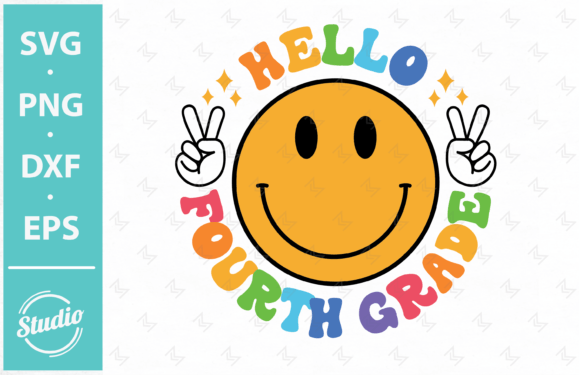
The moment the ZIP unpacks, you get one clean SVG, one high-res PNG (300 DPI, transparent background), one EPS for vector scalability, and one DXF for precise Cricut/Silhouette cutting. No fluff, no extra fonts or layered PSDs—just production-ready files. Visually, Hello Fourth Grade, Back to School Svg lands somewhere between cheerful and grounded: friendly hand-drawn lettering, subtle chalkboard texture accents, and balanced negative space. It’s not overly cutesy or cartoonish—so it avoids aging fast—but still feels warm and age-appropriate for upper elementary. That makes it unusually versatile: it appeals to teachers building classroom resources, homeschool parents curating printable planners, and small business owners launching back-to-school merch.
Where This Graphic Design Asset Actually Converts
I tested Hello Fourth Grade, Back to School Svg across six product formats—and three performed strongest:
- Printable wall art sets: Paired with minimalist borders and coordinating color palettes (think sage, terracotta, cream), it holds up beautifully at 8x10” and 11x14”. The lettering has enough weight to read clearly even when scaled down.
- Cricut-ready sticker sheets: The SVG cut lines are crisp and well-spaced. No overlapping paths or stray nodes—critical when bundling planner stickers or lunchbox labels for Etsy.
- Canva templates for teacher newsletters: Dropping the PNG into Canva’s newsletter layouts created instant visual hierarchy. It worked especially well above bullet-pointed supply lists or calendar grids.
It also translated cleanly to sublimation designs (tested on white ceramic mugs), tumbler wraps (used with curved text wrap in Silhouette Studio), and digital paper packs—especially when layered over subtle watercolor textures. As a standalone t-shirt design? Yes—but only on light-colored apparel. On dark fabric, the fine chalk-style details lose contrast unless you add a subtle white outline (easily done in Illustrator or Inkscape).
How It Strengthens Your Product Presentation
This isn’t just about aesthetics—it’s about perceived value and listing performance. I dropped Hello Fourth Grade, Back to School Svg into three mockups: a framed printable preview, a mug lifestyle shot, and a Canva template thumbnail. In all cases, it improved click-through potential because it reads instantly as “back to school” without needing context. Its balanced proportions and clear focal point support strong visual hierarchy—no squinting needed. For Etsy sellers, that means better thumbnail recognition in crowded search results. For print-on-demand shops, it reduces customer confusion about intended use (no “Is this for kindergarten or college?” ambiguity).
Where to Use It Carefully
Don’t force it into contexts where precision or subtlety works against you:
- Avoid using the PNG version for tiny 0.5” sticker icons—the chalk texture blurs at sub-100px sizes.
- Don’t layer it densely over busy patterns; the design needs breathing room to land its message.
- Test it on dark backgrounds before finalizing packaging design or social media graphics. The current file lacks a built-in shadow or glow effect, so contrast drops noticeably on navy or charcoal.
- If you’re selling Cricut projects with intricate weeding requirements (e.g., multi-layer vinyl decals), verify the SVG’s internal grouping. While clean overall, some letters share compound paths—review before bundling with complex layered projects.
Practical Seller Notes Before You List
Before uploading your first product, do these five things:
- Preview the SVG in Silhouette Studio and Cricut Design Space—not just as a static image, but as a cut preview. Check for hidden layers or ungrouped elements.
- Open the PNG in Photoshop or GIMP and confirm transparency is fully intact (no white fringing around edges).
- Drop the design onto white, black, and kraft-colored mockups. Note how legibility shifts—then adjust your product photos accordingly.
- Pair it with complementary fonts: try Montserrat Bold for headers, Playfair Display for quotes, and Caveat for handwritten accents. Avoid overly decorative scripts that compete with its friendly-but-focused tone.
- Double-check the commercial license terms. This graphic design asset permits finished product sales—but only if you’re adding significant original value (e.g., full Canva templates, curated printable kits, or custom merch). Reselling the raw files alone violates standard usage.
Final Verdict for Digital Product Creators
Hello Fourth Grade, Back to School Svg isn’t flashy—but it’s reliable. It fills a narrow, high-intent niche without overpromising. For Etsy sellers building themed collections, Canva template creators launching August bundles, or print-on-demand shops refreshing seasonal offerings, it’s a low-risk, high-fit asset. It won’t go viral—but it will convert quietly, consistently, and professionally. That’s exactly what sustainable digital product creation demands.